
If you are researching the amaranth FOB price in India for a bulk purchase, the first problem you will encounter is that there is no single market price. If you have ever received a price quote from an Indian amaranth supplier and wondered why the number looks so different from what you see on commodity platforms, you are not misreading the data. The gap is real, it is significant, and it is one of the most common sources of confusion for buyers sourcing amaranth from India for the first time.
This guide explains exactly what drives amaranth pricing at every stage of the supply chain, what you should realistically expect to pay FOB Mundra in 2026, how organic and conventional grades compare on price, and most importantly, when to lock in your annual contract to protect your margin.
We are not going to give you a single number and call it a price. Amaranth does not work that way. What we will give you is the framework to understand pricing, ask the right questions, and make a sourcing decision that holds up twelve months from now.
What Is the Amaranth FOB Price in India Right Now?
The Number That Confuses Most Buyers First
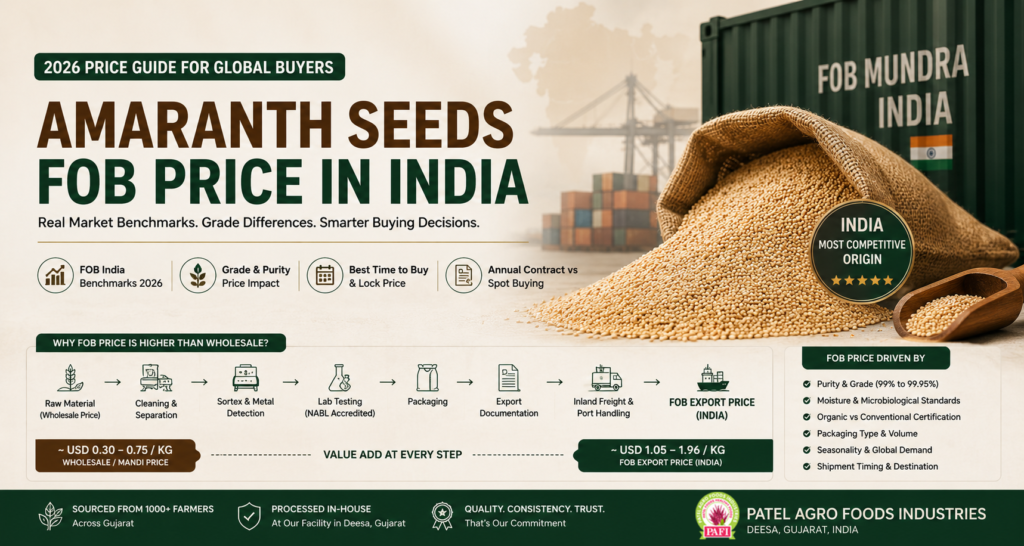
When importers start researching the amaranth FOB price in India before approaching exporters, they typically encounter two numbers that do not match, they often find wholesale or mandi prices from agricultural commodity platforms. These numbers look attractive, recent wholesale price updates from India show amaranth ranging from $0.30 to $0.75 USD per kg across early 2026, which at current exchange rates feels like the ballpark they expected.
Then they receive a FOB quotation from an exporter and the number is USD 1.10 to USD 1.80 per kg. Sometimes higher for organic. The reaction is usually one of two things: the buyer assumes the exporter is inflating margin aggressively, or they assume the commodity platform is showing outdated data.
Neither is accurate.
What Export Transaction Data Actually Shows
Here is what the data actually shows. Sampled export transaction prices for amaranth grain from India in early 2026 ranged from USD 1.05 to USD 1.96 per kg across transactions recorded between February 1 and February 27, 2026. Globally, India’s average benchmark transaction price in February 2026 was USD 1.25 per kg significantly below Peru at USD 2.97 and Mexico at USD 1.38 making India the most competitively priced origin for export-grade amaranth grain among the major supplying countries
That gap between roughly USD 0.30 to 0.75 at the mandi and USD 1.05 to 1.96 at FOB export level is not a markup. It is the cost of turning raw agricultural produce into export-compliant, tested, packed, documented, and port-delivered commodity.
Understanding what sits in that gap is what allows a buyer to evaluate whether a quotation is fair and whether two quotations from different suppliers are even comparing the same thing.
All pricing data cited in this guide is indicative market benchmark drawn from public trade intelligence sources. This is not a price quotation from Patel Agro Foods Industries. Actual prices depend on grade, quality, quantity, certification, packaging, Incoterm, shipment timing, and destination.
Why is the Amaranth FOB Price in India Higher than the Wholesale/Mandi Price?

The wholesale or mandi price is what a farmer or local aggregator receives for raw seed at the local agricultural market. It reflects supply and demand at the village or district level on a given day. At this stage, the seed may still contain dust, stones, immature grain, straw and variable moisture, because the price reflects the raw commodity rather than an export-ready ingredient. A food manufacturer in Rotterdam or a health food distributor in Sydney therefore cannot compare this figure directly with the price of a cleaned, tested and shipment-ready export lot.
Between the wholesale/Mandi and your container, the following steps add real cost.
Primary cleaning
Rotary sieves and destoners remove stones, straw, and large foreign matter. Raw amaranth from the farm routinely contains 3 to 8 percent material that fails this first screen, that material is either discarded or downgraded to animal feed. The weight loss is a real cost.
Gravity separation
Density-based separation removes light, shrivelled, immature, or damaged seeds that passed the initial cleaning but would fail purity tests. This step is what separates processors from traders who simply clean and bag.
Optical colour sorting (Sortex)
The machine every serious food-grade buyer should ask about. Colour-based optical sorters remove discoloured, mouldy, and off-grade seeds seed-by-seed. Single-pass Sortex achieves standard export purity. Double-pass is required for 99.5% or 99.95% grades. Each pass adds processing time, machinery cost, and yield loss.
Metal detection
Mandatory for food-grade export. Every lot passes through metal detectors, and records are maintained per lot.
Laboratory testing
For any serious export shipment and certainly for EU, US, or Japanese buyers, every lot requires third-party NABL-accredited lab testing covering purity, moisture, FFA (where applicable), Total Plate Count, Yeast and Mould, Salmonella per 25g, E. coli per 25g, and aflatoxin (B1, B2, G1, G2, total). For EU shipments, a pesticide residue MRL compliance report is effectively non-negotiable. These tests are time-consuming, have a real cost, and cannot be rushed without compromising their integrity.
Packaging
Whether 25kg moisture-sealed PP woven bags, 50kg jute bags, or FIBC jumbo bags, packaging involves material cost, labour, stitching, labelling, and weight compliance checks. It is not an afterthought.
Export documentation
Phytosanitary certificate from the Plant Quarantine Authority of India, Certificate of Origin from APEDA or Chamber of Commerce, Commercial Invoice, Packing List, Bill of Lading, each involves fees, coordination, and time. For organic lots, add Transaction Certificate fees under EU Regulation 2018/848 or USDA NOP certification costs.
Inland freight and port handling
Trucking from Deesa, Banaskantha to Mundra Port is approximately 200 km. Container stuffing, port handling charges, and export clearance fees apply at Mundra regardless of commodity value.
When you add every layer above, the gap between a USD 0.50 wholesale price and a USD 1.30 FOB price is not exporter margin, it is the documented cost of producing a compliant, tested, shipment-ready export lot from raw grain.
At Patel Agro Foods Industries, we process directly from our own facility in Deesa, sourcing from over 1,000 registered farmers in the Banaskantha cultivation zone. Procurement is direct, which removes one intermediary cost layer that some exporters carry when sourcing through aggregators. But the processing cost structure described above applies to any serious export supplier.
What Drives the Amaranth FOB Price in India?
Several variables move the price of export-grade amaranth independently of each other. Knowing which ones apply to your specific requirement is what allows you to evaluate a quotation correctly rather than simply comparing headline numbers.
Raw Material Cost and Indian Crop Conditions
Crop size, farmer selling behaviour, domestic demand and regional weather conditions all influence raw material procurement costs. Gujarat’s Kharif crop, the primary amaranth harvest is the biggest seasonal driver. A good harvest creates procurement optionality and competitive raw material pricing. A poor harvest reduces supply, tightens inventory, and pushes raw material cost up regardless of what the previous season’s data showed.
Processing Grade and Purity
Processing grade and Purity are probably the single largest variable in any exporter quotation for the same commodity. Standard export grade (99% purity) requires one cleaning pass and standard Sortex. Premium food grade (99.5% or 99.95% purity) requires tighter cleaning, double-pass Sortex, and higher rejection of borderline lots, all of which raise processing cost meaningfully. Do not compare two price quotes without confirming that both are quoting the same purity specification.
Moisture content
Moisture affects both quality and yield. Achieving moisture below 8% consistently requires controlled drying and storage infrastructure. A supplier consistently hitting 8% moisture is operating differently from one supplying at 10 to 11% and their processing cost reflects that.
Packaging format
Packaging can also move the final FOB quotation more than many buyers expect. A 25kg moisture-sealed PP bag costs more per MT to produce than an FIBC jumbo bag but may be the only practical format for your receiving infrastructure. Jute bags carry a premium over PP bags. Always specify your packaging requirement accepting a supplier’s default packaging can mean paying for something you cannot use efficiently.
Volume
The quantity you order has a direct effect on the price per MT. A 1 MT trial shipment is priced differently from a 20 MT full container load, which is priced differently again from an annual contract covering multiple containers. Ask your supplier to provide tiered pricing so you understand how scale affects your per-kg cost.
Certification
It is covered in detail in the next section.
Lead time and urgency.
Standard lead time from order confirmation to container loading at Mundra is 2 to 3 weeks for conventional amaranth and 3 to 4 weeks for organic certified lots. If a supplier quotes significantly faster, ask whether they are processing a fresh lot against your specification or supplying from existing processed stock. Both are legitimate but they are different products with different provenance.
Each of these variables explains why the amaranth FOB price in India can differ by 30 to 40 percent between two exporters quoting what looks like the same product
How Grade and Specification Affect the Amaranth FOB Price in India?
Rather than presenting a price table that would be outdated before this page is read, the more useful framework is understanding the price relationship between specification levels.
Standard export grade – 99% purity, moisture max 10%
The entry point for commodity buyers, industrial processors, and buyers who will do further processing at destination. Meets minimum food-grade export specification. Priced at the lower end of the FOB range.
Premium food grade – 99.5% purity, moisture max 8%, full Sortex, lot-wise lab testing
Preferred by food manufacturers using amaranth as a visible ingredient in retail products – granola bars, breakfast cereals, bread toppers, health food packs. The additional processing cost and tighter rejection criteria translate into a real price premium over standard grade, typically 8 to 15 percent higher.
Ultra-premium grade – 99.95% purity, double-pass Sortex, NABL-accredited testing per lot, enhanced moisture control
Required by buyers with the most exacting specification – baby food manufacturers, premium nutraceutical brands, EU retail organic labels. Carries the highest processing cost premium.
Feed or B-grade
Lots that do not meet food-grade specification on purity or microbiological parameters are sold at a significant discount for animal feed or industrial use. If a supplier is quoting you a price that feels unusually low, clarify the grade explicitly and request the COA before assuming it is food-grade material.
The practical consequence
if one supplier quotes USD 1.10 and another quotes USD 1.35 for “amaranth seeds,” and you have not confirmed that both are quoting 99.5% purity with moisture max 8% and lot-wise third-party testing, you are not comparing prices. You are comparing descriptions.
Organic vs Conventional Amaranth FOB Price in India: The Honest Picture
Why Organic Amaranth Has a Higher FOB Price
Organic certified amaranth carries a price premium over conventional. The premium exists for reasons that are real and documented, not marketing positioning.
Certified organic farms operate under an inspection and audit regime that adds cost for the farmer. Processing facilities handling organic material must maintain segregated storage and processing lines to prevent commingling with non-organic lots, this is a real infrastructure and operational cost. Transaction certificates under EU Regulation 2018/848, or USDA NOP certification compliance, add documentation cost and time per shipment. The certified organic farmer pool is smaller than the conventional pool, which means supply is structurally tighter.
What Determines the Organic Price Premium?
The premium is not fixed. It varies with organic certification type, available supply in the current season, your destination market’s documentation requirements, the certification body involved, and order volume. A small organic trial order carries a different premium profile from an annual supply contract.
For a detailed, practical breakdown of everything that changes when you move from conventional to organic procurement – certification by market, documentation requirements, supply chain differences, and the questions to ask a supplier before committing – see our Organic vs Conventional Amaranth Seeds Importer’s Guide.
Seasonal Amaranth FOB Price Patterns in India
How the Kharif Harvest Affects Amaranth FOB Pricing
Amaranth in India is primarily a Kharif crop, planted in June and July during the monsoon and harvested between September and November depending on the district. A secondary Rabi crop is produced in some regions. Understanding this cycle is useful context, but it is not a formula for guaranteed price advantages.
Why October Does Not Always Mean the Lowest Price
Fresh crop arrival after the Kharif harvest typically October onwards, tends to increase supply availability. When the harvest has been good and farmers are actively selling into the market, raw material procurement costs can be favourable, and that can flow through to export quotations from processors with active procurement operations. This is a real pattern, not a myth.
However, several things can break that pattern in any given year. A crop that is good in volume but poor in quality due to excess monsoon moisture creates higher processing rejection rates, which offsets the volume advantage. Domestic demand can also affect export procurement. Rajgira is widely consumed during Navratri and other fasting periods. Strong domestic demand can compete with exporters for the same raw material. Exporters who have already contracted forward sales at pre-harvest prices may not be able to offer post-harvest price advantages to spot buyers.
What This Means for Importers
The practical implication is not “always buy in October.” It is: if your annual consumption is material and your inventory position allows you some flexibility, aligning at least part of your procurement cycle with post-harvest availability is a reasonable strategy. Buyers who operate entirely on spot purchases with no forward planning consistently face the worst pricing windows not because they are unlucky, but because they are buying when their urgency is highest and their leverage is lowest.
Amaranth FOB Price Strategy: Spot Buying vs Annual Contracts
This is a question we hear regularly from buyers in the mid-volume range typically 5 to 25 containers per year. There is no universal answer. Here is the honest framework.
When Spot Buying Makes Sense
When your demand is genuinely variable or unpredictable, you are trialling a new product or application and do not yet know your annual consumption, or you are evaluating a new supplier and want to assess quality and service delivery before committing to volume. For buyers in this position, spot purchasing preserves flexibility and limits commitment risk. In each of these cases, monitoring the amaranth FOB price in India on a per-shipment basis is a reasonable approach.
When Quarterly Procurement Makes Sense
Buyers with reasonably predictable consumption who want some pricing stability without a full annual commitment. Prices are agreed per quarter based on market conditions at the time of ordering. This model gives a supplier enough visibility to manage raw material procurement without requiring the buyer to take on full annual price risk.
When an Annual Contract Makes Sense
Food manufacturers and Ingredient distributors with defined annual volume and the operational capacity to take consistent delivery. The common misconception is that an annual contract means fixing one price for twelve months. It does not have to work that way. Annual contracts can be structured as fixed price, quarterly price revision clauses, formula-based pricing linked to an agreed market index, volume-based price tiering, or crop-season pricing triggers. The right structure depends on your risk appetite and the supplier’s willingness to commit to volume. Freight and currency conditions at the time of negotiation also matter.
The Hybrid Procurement Model
Contracting 60 to 70 percent of annual volume at post-harvest pricing and leaving 30 to 40 percent on a quarterly or spot basis works well for buyers who want most of the price advantage of forward buying while retaining flexibility for volume changes. It is a sensible middle ground for buyers in the 10 to 30 container per year range.
A Special Consideration for Organic Amaranth
Any supplier offering a fixed twelve-month organic price without qualifying it against certification continuity and organic harvest volume is either very confident or not fully thinking through the supply risk. Before signing an annual contract for organic lots, ask your supplier explicitly how they manage organic supply continuity across crop seasons, including what happens to your supply commitment if the certified crop is below expectation in a given year.
How to Compare Amaranth FOB Quotations in India
This is where most buyers lose clarity. A quotation at USD 1,150 per MT from one supplier and USD 1,300 per MT from another tells you almost nothing until you have confirmed that both quotations are describing the same product under the same commercial terms.
Before comparing two prices, verify each of the following methodically, not as a formality.
Product specification
Purity percentage. Moisture maximum. Admixture and foreign matter limits. Microbiological requirements, Salmonella, E. coli, Total Plate Count, Yeast and Mould. Aflatoxin limits. FFA where applicable. A 0.5% difference in purity specification can represent a meaningful difference in processing cost and end-product performance.
Processing level
Has the seed been cleaned only, or also gravity-separated and colour-sorted? Single-pass or double-pass Sortex? Is testing per lot or periodic? This determines consistency across shipments not just the quality of the sample you approved.
Packaging
25kg PP bags, jute bags, FIBC different formats have different per-MT costs and different implications for your receiving infrastructure.
Incoterm
FOB and CIF are not directly comparable without knowing the freight cost. Two FOB quotations from different origin ports carry different freight rates to your destination and are not directly comparable on price alone.
Payment terms
30% advance with 70% against BL has different working capital implications from LC at sight. This affects your effective cost even when the headline price is the same.
Price validity
Most Indian commodity quotations are valid for 5 to 7 days given agricultural price movement. A quotation from last week may not reflect today’s market, confirm validity before using it in a comparison.
Documentation inclusions
Does the quotation include COA, phytosanitary certificate, and certificate of origin as standard? EU shipments require a pesticide residue MRL compliance report, is that included or charged separately? US-bound shipments require FDA Prior Notice. Ask before assuming.
Pre-shipment inspection availability
Is SGS or Intertek inspection available if you request it? Is it at buyer’s cost or included? For first-time orders with a new supplier, third-party inspection is effectively insurance, it is worth asking about upfront.
Once both quotations have been normalised against each of these variables, price comparison becomes meaningful. Before that point, it is not. If you are still evaluating which Indian supplier can consistently meet your required specification, see our guide to choosing an amaranth seeds exporter from India.
What to Include in an Amaranth FOB Price RFQ
A well-constructed RFQ gets a precise, useful response. A generic price enquiry gets a number that tells you very little. If you are approaching Indian amaranth suppliers, including the following in your initial enquiry will produce quotations you can actually work with.
Required quantity in metric tons, and whether this is a one-time purchase or part of ongoing consumption. Your specification requirements – purity, moisture, microbiological parameters, aflatoxin limits. Whether you require organic or conventional, and if organic, which certification EU 2018/848, USDA NOP, or both. Your destination port and preferred Incoterm. Packaging format. Your preferred shipment window. Any documentation requirements specific to your import market. Whether pre-shipment inspection is required, and by which body.
A supplier who receives this information can provide a current, precise, valid quotation. A supplier who receives “please send your best amaranth price” will send a number that creates more questions than it answers.
When to Lock In Amaranth FOB Price: A Framework, Not a Formula
Lock In Amaranth FOB Price When Demand Is Predictable
There is no single right answer for when to lock amaranth price. But there are conditions that consistently indicate it is the right time to commit.
Lock price when you have confirmed production volume or sales commitments that give you reasonable visibility on quarterly or annual consumption. Locking price without underlying demand creates inventory risk that offsets any price advantage you captured.
Consider forward pricing after fresh crop confirmation not because prices are guaranteed to be at their lowest, but because post-harvest is when supply is most available and suppliers are most willing to negotiate on volume-based terms. The combination of supply availability and your purchasing credibility is strongest at that moment.
Consider Formula-Based Pricing for Annual Contracts
For annual contracts, consider formula or index-linked pricing rather than a fixed price if the market has shown volatility. A formula tied to an agreed benchmark with a defined quarterly revision window gives both parties a transparent mechanism and removes the pressure of trying to predict twelve months of price movement correctly.
For buyers who are new to Indian sourcing regardless of how attractive an annual contract price appears the right sequence is almost always: trial shipment first, assess quality and service delivery, then negotiate ongoing supply terms. A good price on the first container means little if documentation surprises or quality inconsistency emerge on the third.
Final Takeaway: Compare the Specification, Not Just the Price
The most useful amaranth price is not necessarily the lowest number on a supplier quotation. For international buyers, the real comparison starts with the specification, processing level, certification, packaging, Incoterm, volume and shipment timing behind that number.
If you are comparing Indian suppliers, establish the same specification first and then compare FOB or landed cost on an equivalent basis. That gives you a much clearer view of whether a quotation is genuinely competitive.
If you need a current amaranth FOB price in India, send your required quantity, specification, packaging requirement and destination port. We can then quote against the requirement rather than giving you a generic market number.
Frequently Asked Questions About Amaranth FOB Prices in India
What is the current amaranth seeds price per kg in India in 2026?
There is no single price. Wholesale, export and FOB prices vary by grade, quantity, certification, packaging and timing.
Why is the FOB price higher than the wholesale/mandi price?
FOB pricing includes processing, sorting, testing, packaging, inland freight, export documentation and port handling in addition to the raw seed cost.
Is India the most competitive origin for amaranth in 2026?
Based on available trade data, yes. India’s average transaction price of USD 1.25 per kg in February 2026 was significantly below Peru at USD 2.97 per kg and Mexico at USD 1.38 per kg, making India the most competitively priced major origin for export-grade amaranth grain.
What affects the FOB amaranth price most?
Raw material procurement cost, processing grade and intensity, moisture specification, packaging format, certification type, and order volume are the primary drivers. Currency and freight affect landed cost but not the FOB price itself.
Is organic amaranth more expensive than conventional?
Yes, typically, but the premium varies considerably by certification type, available organic supply in the current season, documentation requirements, and volume. The premium reflects real costs including segregated processing, certification audit fees, and transaction certificate requirements. For a full breakdown, see our Organic vs Conventional Amaranth Guide.
When is the best time to buy amaranth from India?
Post-Kharif harvest, typically from October onwards, can create favourable buying conditions when supply is strong. But this is not guaranteed and depends on crop quality, domestic demand, and existing exporter inventory. The best time to buy is when your consumption cycle and inventory position allow you to act with reasonable lead time, rather than when you are running short.
How do I compare two Indian amaranth supplier quotations?
Normalise the specification first: purity, moisture, processing level, packaging and microbiological requirements. Then confirm Incoterm, port of loading, payment terms, price validity and documentation inclusions.
Can I get a current FOB quotation from Patel Agro Foods Industries?
Yes. Send your required quantity, grade specification, organic or conventional status, packaging preference, destination port and Incoterm to [email protected]. We respond with a current price indication within 24 business hours.
Request a Quotation
Whether you are building your first amaranth supply line, reviewing your current sourcing arrangement, or preparing an annual procurement plan, we are available to support your process.
We can provide a current FOB or CIF quotation for your specification and volume, a sample for quality evaluation before commitment, our standard specification sheet and recent lot-wise COA, packaging options and lead time confirmation, and a full documentation breakdown for your import market.
E-mail: [email protected] | Phone: +91 98254 58490 | Sourcing Enquiry Form →
View Amaranth Seeds product page →
We respond to all importer enquiries within 24 business hours.