
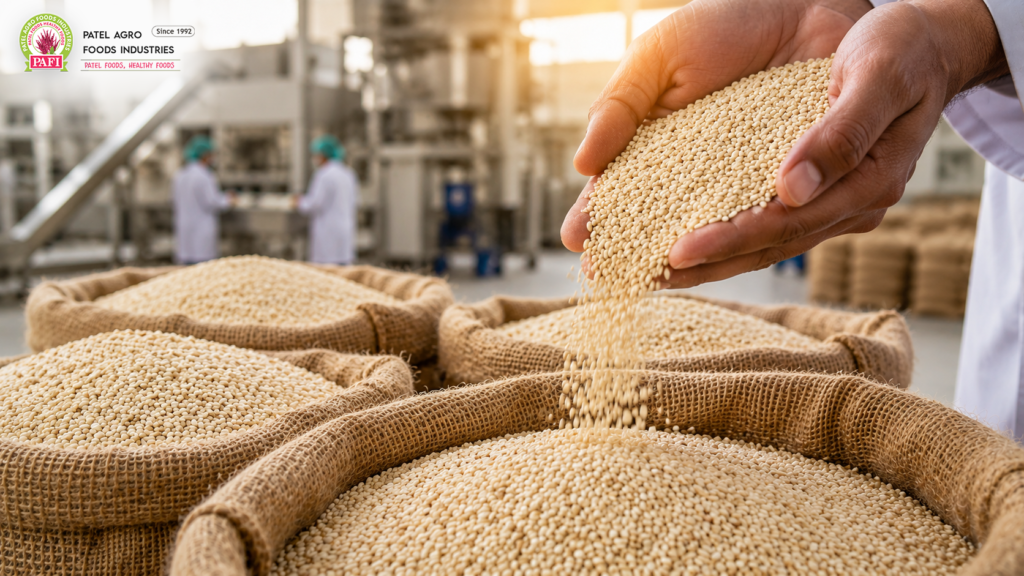
Whether you’re looking for a reliable sesame seeds exporter from India for bakery products, tahini production, oil extraction, health foods, or private label brands, selecting the right supplier involves much more than comparing FOB prices. The origin of the sesame, processing methods, food safety standards, export documentation, and supply consistency all play a crucial role in the success of your procurement.
India is one of the world’s leading producers and exporters of sesame seeds, supplying premium-quality white, black, hulled, and unhulled sesame to food manufacturers, ingredient distributors, commodity traders, and private label brands across Europe, North America, the Middle East, Australia, and Asia. As a trusted sesame seeds exporter from India, Patel Agro Foods Industries works closely with international buyers seeking reliable quality, transparent documentation, and long-term supply partnerships.
In this comprehensive guide, you’ll learn the differences between white, black, hulled, and unhulled sesame seeds, understand the quality standards and certifications required by major export markets, and discover what to consider before selecting the right sesame seeds exporter from India for your business.
India’s Sesame Industry: Why Thousands of Importers Choose India Over Sudan, Ethiopia, and Nigeria
Sudan, Nigeria, and Ethiopia collectively produce large volumes of sesame, but Indian sesame earns consistent preference from EU, US, Japanese, and Middle Eastern buyers for reasons that go beyond price:
Crop diversity and multiple harvests. India produces sesame across two seasons: Kharif (summer crop, harvested September–November) and Rabi (winter crop, harvested February–April), giving importers year-round supply continuity that single-season African origins cannot match.
Gujarat: India’s sesame heartland. Gujarat accounts for approximately 70% of India’s total sesame production. Specifically, the Banaskantha, Kutch, and Surendranagar districts produce the high-oil, high-purity white sesame that EU bakery manufacturers and Japanese food processors prefer. Patel Agro Foods Industries is based in Deesa, Banaskantha, within 50 km of India’s densest sesame cultivation zones. Our procurement team buys directly from over 1,000 registered farmers Network, eliminating the broker layers that inflate cost and reduce traceability in other origins.
Export infrastructure. Mundra Port, Gujarat – one of India’s largest private container terminals handles the majority of Indian sesame exports. From Deesa to Mundra is approximately 200 km with reliable road freight. Transit times from Mundra to Rotterdam average 18–22 days; to Los Angeles 22–26 days; to Dubai 6–9 days.
Processing quality. Indian sesame exporters who own in-house processing facilities (gravity separation, Sortex optical sorting, colour sorting, metal detection) deliver more consistent purity than African origins where field-level sorting is common. This difference shows in reduced rejection rates at destination ports.
Documentation reliability. India’s APEDA-registered exporters operate under a regulated export framework with standardised documentation. Phytosanitary certificates are issued by government Plant Quarantine authorities. For EU importers, this matters significantly.
Sesame Seeds Exporter from India Guide: White vs Black vs Hulled Sesame

One of the first questions buyers ask is not simply “Can you supply sesame seeds?” but “Which type of sesame is right for my application?”
Each variety offers different characteristics, processing requirements, flavour profiles, and commercial applications. Selecting the correct grade helps improve manufacturing efficiency, product appearance, and overall value for your end customers.
Types of Sesame Seeds Exported from India:
| Sesame Type | Appearance | Common Applications | Major Export Markets |
|---|---|---|---|
| White Hulled Sesame | Bright white, smooth surface | Bakery, hamburger buns, tahini, confectionery | Europe, USA, Middle East |
| White Natural (Unhulled) Sesame | Cream to light brown | Oil extraction, industrial processing, food ingredients | Middle East, Africa, Asia |
| Black Natural Sesame | Black outer coat | Traditional Asian foods, confectionery, health foods | Japan, Korea, China |
| Black Hulled Sesame | Premium processed black sesame | Functional foods, premium retail products | Japan, South Korea, Specialty Markets |
Patel Agro Foods Industries supplies all major commercial sesame varieties depending on buyer specifications, destination market requirements, and processing applications.
View our complete range of white, black, hulled, and natural sesame seeds.
Why Indian Sesame Outperforms on Quality: What the Specs Actually Mean
Most sesame spec sheets list purity, moisture, and FFA. Few suppliers explain why each parameter matters for your end application. Here is what you are actually buying when you sign off on a COA:
Purity (99% / 99.5% / 99.95%):
Purity refers to the percentage of whole, clean sesame seeds in the lot. The remainder is foreign matter, other seeds, dust, stones, and damaged kernels. For retail applications, minimum 99.5% is required. For industrial use, 99% is acceptable. Our standard is 99.5% minimum for all export lots, with 99.95% achievable for premium grades through double Sortex sorting.
Moisture (max 8% / 10%):
Moisture above 10% creates two problems: mould growth during sea freight transit (especially in humid monsoon-season shipments) and reduced oil content per kg. We pack all sesame in moisture-sealed PP woven bags. For tropical destination markets (Southeast Asia, Middle East), we recommend 25kg bags over FIBC jumbo bags to reduce moisture ingress risk during multiple container transfers.
FFA – Free Fatty Acid (max 1.5% / 2%):
FFA indicates oxidation level, how much the oil in the seeds has begun to break down. High FFA produces rancid flavour and reduces shelf life. For tahini and oil applications, importers should insist on FFA below 1.5%. FFA rises during storage always request a lot-specific COA dated within 30 days of shipment.
Oil Content (min 45% / 48% / 50%):
Higher oil content = more tahini or oil yield per kg. Natural white sesame typically hits 48–52% oil content. Hulled sesame is slightly lower (45–48%) because the hull contributes to oil weight. Premium oil-extraction buyers should specify minimum 48% oil content in their purchase agreement.
Aflatoxin (total max 10 ppb / 20 ppb):
Aflatoxin is the most common cause of sesame import rejections at EU and Japanese ports. It is a mycotoxin produced by Aspergillus mould during storage. We test every lot for Total Aflatoxin (B1+B2+G1+G2) at a NABL-accredited third-party laboratory. EU limit: B1 max 5 ppb, total max 10 ppb. Japanese limit: total max 10 ppb. US: max 20 ppb. Request the aflatoxin test report specifically, it should be on the COA alongside microbiological results.
Microbiological: Salmonella (absent per 25g), E. Coli (absent per 25g):
Non-negotiable for all food-grade export. We test every commercial lot. Steam sterilisation is available on request for buyers in markets with stricter micro requirements (Japan, Australia).
Certifications & Compliance: What Different Markets Require
Every sesame seeds exporter from India supplying international markets must understand destination-specific compliance requirements. Understanding these expectations before placing an order helps reduce customs delays, avoid unnecessary inspections, and ensure smoother import clearance.
Experienced exporters work closely with buyers to prepare the documentation required for each destination market.
European Union importers:
- APEDA registration certificate (verifies Indian government-registered exporter)
- Phytosanitary certificate (issued by Plant Quarantine Authority of India)
- Certificate of Origin (issued by Chamber of Commerce / APEDA)
- EU Pesticide Residue (MRL) Compliance Report – for EU, max residue limits under Regulation EC 396/2005 apply; sesame has historically triggered EU MRL alerts for pesticides including ethylene oxide (banned in EU). Request explicit MRL compliance for sesame, not just a generic COA.
- For organic: Transaction Certificate under EU Regulation 2018/848
United States importers:
- FDA Prior Notice (filed electronically before shipment arrives at US port)
- Phytosanitary Certificate
- Certificate of Origin
- COA (lot-wise) – FDA may request during import inspection
- USDA NOP certificate (if organic)
- Importer of Record must hold a valid FDA Food Facility Registration
Japanese importers:
- Phytosanitary Certificate
- Aflatoxin test report (NABL-accredited lab, total aflatoxin max 10 ppb)
- Pesticide residue report covering Japan’s Positive List system (one of the most comprehensive pesticide monitoring systems globally – request supplier compliance explicitly)
- Certificate of Origin
- Sesame destined for Japan should ideally be steam sterilised or heat-treated – confirm with your Japanese buyer’s specifications
Middle East importers (UAE, Saudi Arabia, Kuwait):
- Halal Certificate (if required by buyer – ESMA-accepted bodies preferred)
- Phytosanitary Certificate
- Certificate of Origin
- COA (lot-wise)
- For GCC markets, check country-specific pesticide residue requirements – Saudi Arabia follows Codex Alimentarius limits
Australia and New Zealand:
- Phytosanitary Certificate
- Certificate of Origin
- COA with microbiological results
- FSANZ compliance – sesame is a declared allergen in Australia; packaging and documentation must reflect this
- Some Australian importers request pre-shipment inspection by SGS or Intertek
We provide the complete document set for your destination market with every shipment – including market-specific compliance reports. No documentation surprises at customs.
Sesame Seeds Exporter from India: Packaging & Export Logistics
A professional sesame seeds exporter from India should also offer packaging solutions suitable for different industries and shipping conditions.
25kg PP woven bags (standard) Best for: food manufacturing intake, retail brand buyers, buyers who break bulk on arrival. Easier to handle in warehouses. Moisture-sealed inner liner available on request. A standard 20ft FCL holds approximately 800 bags (20 MT); 40ft FCL holds approximately 880 bags (22 MT).
50kg PP woven bags Best for: commodity traders and oil extraction plants with bulk handling equipment. Reduces bag count per container, slightly lower per-kg packaging cost. Not recommended for humid destination climates without inner moisture liner.
FIBC Jumbo Bags (500kg / 1MT) Best for: large-scale oil mills and industrial processors with forklift handling. Maximum container utilisation. Not recommended for destinations with multiple transshipment points, moisture ingress risk is higher with repeated handling of FIBC bags.
Jute bags (25kg / 50kg) Available for buyers with EU natural packaging requirements or retail sustainability commitments. Lead time is slightly longer. Ask for moisture-treated jute bags for sea freight.
Private label packaging (500g / 1kg / 5kg) We offer retail-ready packaging for food brands and private label importers. Custom printing available. Minimum quantities apply, contact us for private label requirements.
Shelf life: 12 months from processing date, stored below 25°C in dry conditions.
Container loading: We palletise on request for buyers who require palletised delivery at destination warehouse.
Learn more about our available packaging options and commercial specifications on our Sesame Seeds Product Page.
Why Buyers Choose Patel Agro Foods Industries Sesame Seeds Exporter from India
Selecting a long-term sesame supplier is about much more than comparing quotations. Consistency, traceability, processing capability, and dependable communication all contribute to successful international sourcing.
As an experienced sesame seeds exporter from India, Patel Agro Foods Industries focuses on long-term partnerships built on quality, traceability, and reliable exports.
Origin advantage:
Our facility is in Deesa, Banaskantha – in the middle of Gujarat’s sesame belt. We are not trading stock sourced from open markets. We procure directly from our registered farmer network and process at our own facility within 48–72 hours of harvest intake. This reduces the storage window between farm and processing where aflatoxin risk is highest.
In-house processing – not outsourced:
We own and operate our cleaning, gravity separation, Sortex colour sorting, and metal detection lines. This means we control quality at every step and can provide lot-specific traceability from farmer procurement record to outbound COA. Processors who outsource sorting cannot provide this.
Processing capacity and consistency:
We process in defined lots with individual COAs. If you order 3 containers per year, each container gets its own COA – not a shared certificate covering multiple lots. This matters for buyers who face random sampling at destination ports.
Response time:
We respond to all export enquiries with pricing, specifications, and sample availability within 24 business hours. For repeat buyers, we maintain pre-production sample approval records so repeat orders can be confirmed faster.
Documentation speed:
All export documents (Phytosanitary Certificate, Certificate of Origin, COA, Commercial Invoice, Packing List, Bill of Lading) are ready within 3–5 working days of goods being ready. We pre-prepare FDA Prior Notice for US-bound shipments.
34 years of export experience:
Patel Agro Foods Industries has been operating since 1992, through currency fluctuations, freight crises, and pandemic-era port congestion. We have navigated the 2021 EU ethylene oxide MRL alerts on sesame, the 2022 container shortage, and the Red Sea freight disruptions of 2024. Buyers who work with us benefit from that operational experience.
Third-party inspection available:
SGS, Intertek, or Bureau Veritas pre-shipment inspection available on buyer’s account at any time. We have never declined a pre-shipment inspection request.
You can also explore our Sesame Seeds Export Product Page for detailed specifications, packaging options, and enquiry support.
How We Process Sesame Seeds: From Farm to Export Container
Understanding our processing chain answers the question importers rarely ask but always care about: how consistent will quality be between orders?
- Direct farmer procurement : We buy sesame directly from 1,000+ registered farmers in Banaskantha and neighbouring districts. Each farmer lot is weighed, sampled, and moisture-tested at intake. Lots above 12% moisture are rejected or sent for emergency drying.
- Primary cleaning : Rotary sieves, destoners, and aspirators remove stones, dust, straw, and oversized foreign matter.
- Gravity separation : Density-based separation removes light, shrivelled, or damaged seeds. This is the step that significantly improves oil content consistency.
- Optical Sortex sorting : Colour-based sorting removes discoloured, mouldy, or off-grade seeds. Our Sortex machines are calibrated per export grade, white hulled has a tighter colour tolerance than natural sesame.
- Metal detection : Every lot passes through metal detectors before packing. Metal detection records are maintained per lot.
- Microbiological and aflatoxin testing : Samples from each lot are sent to NABL-accredited third-party labs before packing begins. We do not pack export lots until results are received and approved.
- Moisture-sealed packing : Packed in moisture-controlled storage environments. Inner moisture barrier available for humid-destination shipments.
- Pre-shipment inspection : Available on request. Third-party inspection results are shared with buyer before container seal.
Frequently Asked Questions from Sesame Importers
Ready to Source Sesame Seeds from Patel Agro Foods?
We supply bulk sesame seeds to food manufacturers, ingredient importers, commodity traders, and private label brands across the USA, Europe, UK, Australia, UAE, Japan, and more.
To discuss your sesame requirement, contact us with:
- Product type needed (white hulled / white natural / black / organic)
- Destination port
- Required quantity
- Certifications needed
We respond within 24 business hours with pricing, purity specifications, and sample availability.
Request samples or pricing:
📧 info@patelagrofoods.com
📞 +91 98254 58490
🔗 Submit an Enquiry
