
Every week, we receive enquiries from importers confused about organic vs conventional amaranth seeds and which option is right for their market: they ordered organic amaranth because it sounded better, paid a 35% price premium, and then discovered their end customer neither knew nor cared about the certification. Or the reverse, they sourced conventional amaranth without checking pesticide compliance and got a consignment held at the EU border.
Neither scenario is acceptable. And both are completely avoidable.
If you are sourcing bulk amaranth seeds from India, whether for food manufacturing, health food retail, flour milling, or distribution – this guide will give you the framework to make the right call the first time.
Organic vs Conventional Amaranth Seeds – Key Differences at a Glance
- Organic amaranth = certified, chemical-free, higher cost
- Conventional amaranth = cost-effective, compliant if tested properly
- Price difference = typically 25–40%
- Decision depends on target market, certification needs, and end use
Organic vs Conventional Amaranth Seeds: Key Differences for Importers
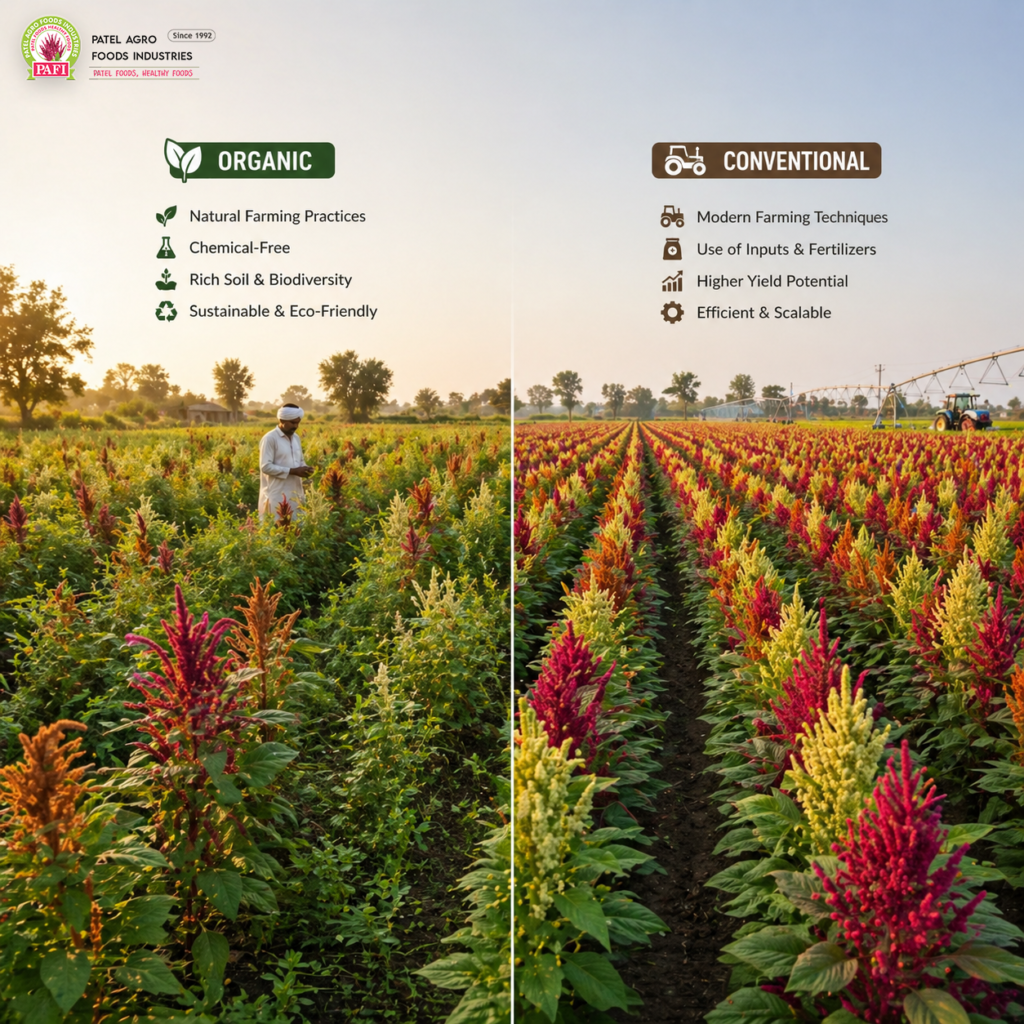
At the farm level, the distinction is straightforward. Organic amaranth is grown without synthetic pesticides, chemical fertilisers, or herbicides — and every step from seed to shipment is audited by an accredited certification body like Control Union, ECOCERT, or Skal. Conventional amaranth follows standard agricultural practices without these restrictions or audits.
However, from an importer’s perspective, the real difference is not the seed itself.
A properly processed organic and conventional amaranth seed are nearly identical in:
- Protein content
- Purity
- Taste
- Nutritional value
The real difference lies in:
- Documentation
- Compliance
- Cost structure
- Market acceptance
As a bulk amaranth supplier from India, we often see buyers over-focus on farming methods and under-focus on compliance requirements.
Why Organic Amaranth Costs More – Practical Export Perspective
Organic amaranth from India typically commands a 25 to 40 % price premium over conventional. Here is where that premium actually comes from – not from the seed itself, but from the system around it:
Certification cost — organic certification for the farmer group, the processor, and the exporter runs anywhere from ₹80,000 to ₹3,00,000 per year depending on certifying body and scope. This cost sits in every kilogram you buy.
Lower farm yield — without synthetic inputs, organic amaranth yields are 20 to 30 percent lower per acre. Same land, less output, higher per-unit cost.
Segregation at processing — certified organic grain cannot be processed on the same equipment in the same run as conventional grain without a full line cleaning and documentation trail. This adds processing time, labour cost, and in some facilities, a separate processing fee entirely.
Transaction certificates per shipment — every organic shipment to the EU requires a transaction certificate (TC) issued by the certifying body. Each TC has a cost and a lead time. Delays in TC issuance have held up shipments. This is real operational risk that experienced exporters price into their quotes.
Smaller lot availability — organic amaranth supply from India is concentrated in fewer growing regions and smaller farm clusters. Unlike conventional where a processor can aggregate from multiple large procurement points, organic requires chain-of-custody documentation at each aggregation step. This limits batch sizes and increases per-unit handling costs.
If an amaranth exporter from India offers organic amaranth at the same price as conventional – ask questions. Something in that supply chain is not adding up. For buyers comparing the actual cost of organic and conventional supply, our Amaranth Seeds Price Guide 2026 also explains how certification, grade, processing, packaging and volume affect the final FOB price from India.
Certifications required for Amaranth Import – What to Check, What to Ignore, and What Is Non-Negotiable
This is where most importers either over-complicate or under-check. The certification requirements for organic vs conventional amaranth seeds differ significantly depending on the destination market. Here is the practical breakdown:
For Organic Amaranth
- EU Organic Certificate (Regulation EU 2018/848): If you are importing to Europe, this is non-negotiable. Verify the scope certificate includes amaranth seeds specifically, not just “cereals” in general.
- USDA NOP Certificate: Required for USA market. Since India’s APEDA recognition agreement with USDA ended in 2022, ensure your supplier is certified directly by a USDA-accredited certifying agent.
- Transaction Certificate per shipment: Issued by the certifying body for each specific consignment. Request this before shipment confirmation, not after.
- Non-GMO declaration: Standard for most health food markets. Should accompany every shipment regardless.
For Conventional Amaranth
- Certificate of Analysis (COA) — lot specific: This is the single most important document. Ask for the COA from the actual batch you are purchasing, not a reference COA from three months ago. Check moisture, purity, aflatoxin, and pesticide residue values specifically.
- EU Pesticide Compliance — EC 396/2005: If you are shipping to any EU country, your supplier must be able to demonstrate that pesticide residues in their product are within MRL (maximum residue limits) set under this regulation. This is not optional even for conventional supply.
- Heavy metals report: Within EU limits for lead, cadmium, arsenic, and mercury.
- ISO 22000 or HACCP certification: Confirms the processing facility operates under a documented food safety management system. A supplier without this has no systematic contamination control — walk away.
- Phytosanitary certificate: Issued by the Indian government for every export shipment. Standard, but verify it accompanies documents.
Quality and Risk: Where Conventional Buyers Get Burned and Where Organic Buyers Overpay
The contamination risk profile of organic and conventional amaranth is different, but not in the way most importers assume.
- Pesticide residue risk is higher in conventional supply – but only from suppliers who do not test and document lot-wise. A conventional supplier with regular third-party pesticide testing and EU MRL compliance documentation carries lower actual risk than an organic supplier whose certification has lapsed or whose farm audit was done 18 months ago.
- Microbiological risk – especially Salmonella – is a critical but often overlooked factor. Salmonella contamination does not depend on whether the crop is organic or conventional. It is primarily linked to:
– Poor drying practices
– Contaminated water sources
– Unsanitary storage or handling conditions
For importers supplying food manufacturers or ready-to-eat segments, Salmonella absence (negative/25g) should be verified through microbiological testing in the COA. A supplier without documented microbiological testing introduces significant regulatory and recall risk – particularly in EU and US markets. - Aflatoxin and mycotoxin risk is similar for both types and is a function of post-harvest handling and storage conditions, not farming method. Ask any supplier – organic or conventional – for their aflatoxin test results. Absence of testing is a red flag regardless of certification.
- Supply consistency favours conventional. Organic amaranth supply from India has seasonal gaps. A processor working exclusively with conventional supply from multiple procurement regions can offer larger volumes, shorter lead times, and more consistent lot-to-lot quality. For industrial buyers running continuous production lines, this matters more than certification type.
- Price volatility is higher for organic. Because the organic amaranth supply pool from India is smaller, any bad harvest in key growing regions moves prices significantly. Conventional supply, drawing from a larger and more geographically diverse pool, is more price-stable over a 12-month contract period.
Which Amaranth Should You Actually Buy: A Decision Framework for Importers
Stop thinking about organic vs conventional amaranth as a quality question. Think of it as a market compliance question.
Choose organic amaranth if:
- Your finished product carries an EU Organic, USDA Organic, or equivalent label
- Your retail buyer or brand partner requires certified organic at the ingredient level
- You are selling into Germany, Austria, Switzerland, or Nordic markets where organic retail penetration makes certification a commercial necessity
- You are a nutraceutical or supplement brand where clean-label sourcing is a front-of-pack claim
Choose conventional amaranth if:
- Your product does not carry an organic label on shelf
- You are supplying food manufacturers, flour mills, or industrial processors where amaranth is one of multiple ingredients
- Your target markets are Middle East, Southeast Asia, or food service channels where organic certification is not a mandatory requirement
- Volume consistency and supply reliability matter more than certification type for your production planning
Once you have decided which specification you need, the next step is evaluating the supplier behind it. Our guide to finding an amaranth seeds exporter from India covers processing, traceability, documentation and supplier qualification.
The question that decides it: Does the buyer of your finished product pay a premium for organic on the label? If yes – source organic. If no – you are paying a 35% premium for a certification your customer is not paying you back for. That is a margin problem, not a quality improvement.
How We Source, Process, and Ship: What Patel Agro Foods Industries Actually Offers
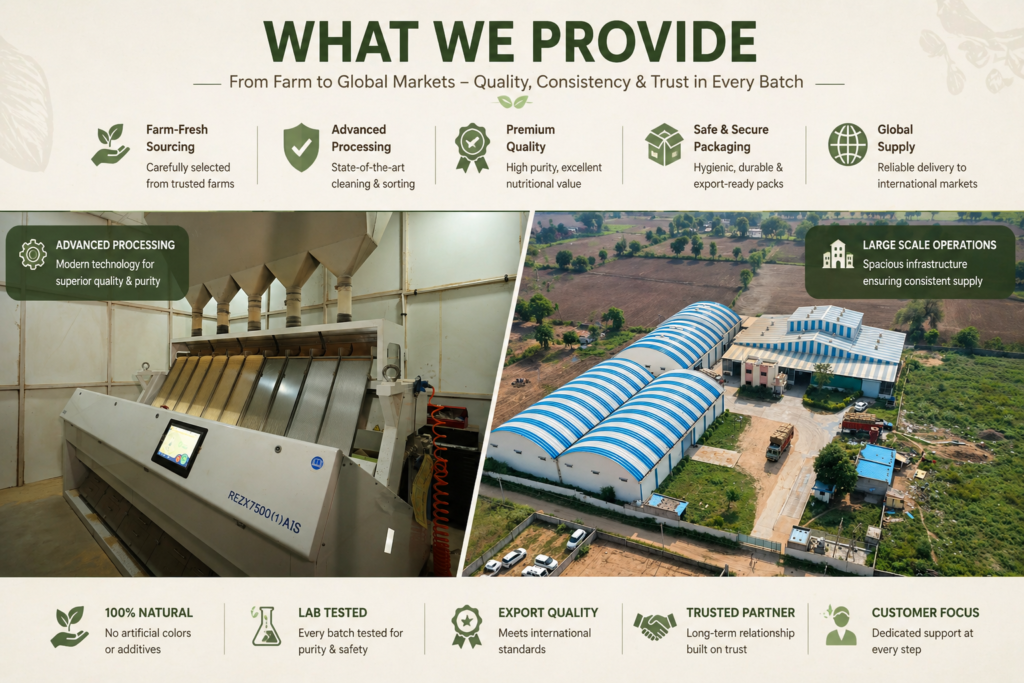
We are not a trading house. We are a manufacturer and exporter based in Deesa, Gujarat — which is India’s primary amaranth growing and processing region. This matters because proximity to source means direct farmer procurement, faster aggregation, and tighter quality control from day one of the supply chain.
We supply both organic and conventional amaranth, depending on buyer requirements. View our premium amaranth seeds specifications and export capabilities.
Sourcing :- Direct procurement from farmer groups in Gujarat. Separate sourcing channels for organic and conventional supply. Organic supply follows certified farm networks with full traceability. Every incoming lot is inspected and documented before processing. No blind aggregation.
Processing :- 9-stage cleaning process including destoning, air classification, sieving, optical colour sorting, and dual-stage metal detection (ferrous and non-ferrous). Output purity: 99% or higher on every lot. Watch our factory tour
Testing :- Lot-wise COA covering moisture, foreign matter, purity, microbiological parameters, and pesticide residue. Third-party testing available on request.
Documentation :- We provide complete export documentation to ensure smooth clearance:
For Conventional Amaranth:
1. Packing list
2. Certificate of Analysis (COA)
3. EU Pesticide Compliance (EC 396/2005)
4. Heavy metals report
5. Phytosanitary certificate
6. Fumigation certificate
7. Bill of Lading
For Organic Amaranth:
1. EU Organic Certificate (EU 2018/848)
2. USDA Organic Certificate (if required)
3. Transaction Certificate (TC) per shipment
4. Non-GMO declaration
5. Full traceability documentation
Packaging :- 25 kg kraft paper bags or FIBC jumbo bags with food-grade inner liners. Custom labelling available. Palletisation as per buyer’s requirement.
MOQ and pricing :- we work with importers from trial shipments upward. FOB Mundra and CIF pricing both available depending on destination. Contact us for a current quote.
For buyers evaluating us as a long-term supplier, we are happy to provide a pre-shipment sample, our full quality documentation package, and references from existing buyers.
Where Amaranth Seeds Are Used: Applications by Industry
Understanding end-use helps you specify the right grade at the enquiry stage:
Food manufacturing: Whole amaranth seeds used in multigrain bread, breakfast cereals, energy bars, and ready-to-eat meals. Requires high purity (99%+), low moisture, and consistent colour. See our full specifications
Health food and retail brands: Typically require non-GMO declaration and either organic certification or documented pesticide compliance. Packaging in consumer-facing sizes from 500g upward available on request.
Flour milling: Amaranth flour is a fast-growing gluten-free ingredient in European and North American markets. Millers source bulk whole seeds for in-house milling. Our sortex-cleaned output is ready for direct milling without additional cleaning steps.
Nutraceutical and supplement manufacturers: Interested in amaranth’s protein profile (13 to 15g per 100g), lysine content, and dietary fibre. These buyers typically require amino acid profile documentation alongside standard COA — available on request.
Animal feed and aquaculture — lower-grade conventional amaranth with relaxed purity specifications. Separate pricing and documentation apply.
For market-specific nutrition and application data, see our Amaranth Nutrition Blog.
Ready to Source Amaranth from India?
If you are importing organic or conventional amaranth seeds, the biggest risks are:
- Choosing the wrong certification
- Overpaying unnecessarily
- Facing import clearance issues
We help buyers avoid all three.
Request sample + latest COA:
Request Samples via Email
Get Specifications Sheet:
Amaranth Specification Sheet
We respond within 24 hours with pricing, documents, and sample dispatch.
FAQs about Organic vs Conventional Amaranth Seeds
What is the price difference between organic and conventional amaranth?
Organic amaranth costs 25–40% more due to certification, lower yields, and segregation requirements.
The premium comes from the supply chain, not major nutritional differences.
COA, phytosanitary certificate, pesticide compliance report are essential for all shipments.
Organic shipments additionally require EU/USDA certification and a transaction certificate.
Yes, if it complies with EU pesticide limits (EC 396/2005) and is supported by a valid COA.
Proper testing and documentation are critical to avoid shipment rejection.
No, organic is only required if the final product carries an organic label.
For bulk or industrial use, compliant conventional amaranth is usually sufficient.
It depends on your market, product positioning, and whether your buyers pay for organic.
Choose organic for premium retail; choose conventional for cost-efficient bulk supply.
