
When a food manufacturer or ingredient importer starts looking for a groundnut kernels exporter from India, finding suppliers is rarely the main challenge. In fact, hundreds of suppliers compete for buyers’ attention. Instead, buyers need to know which questions to ask before placing their first purchase order.
Which grade suits your application? Which kernel count suits your application? More importantly, what aflatoxin limit does your destination market actually require? Check the applicable regulation rather than relying solely on a supplier’s claim. Finally, how does an HPS lot differ from a machine-cleaned lot, and does that difference affect your production process?
This guide answers those questions. It is written for food manufacturers, snack producers, peanut butter brands, ingredient distributors, and commodity traders who are sourcing Indian groundnut kernels for the first time or reviewing an existing supply arrangement.
When choosing a groundnut kernels exporter from India, buyers should first evaluate the product specification, processing capability, traceability and destination-market requirements. Only then should they compare quotations to ensure they are assessing equivalent products and commercial terms.
Why Buyers Choose a Groundnut Kernels Exporter from India
India is a major producer and exporter of groundnuts, supplying kernels to food manufacturers and importers across several markets. According to APEDA data, India exported over 663,000 MT of groundnuts worth USD 690.93 million in FY 2025–26. The principal destinations included Indonesia, Vietnam, Malaysia, China and the Philippines.
Gujarat accounts for a significant share of India’s groundnut production. Within Gujarat, the Saurashtra region covering Rajkot, Junagadh, and surrounding districts is the primary growing zone for Bold kernels. In North Gujarat, Banaskantha produces both Bold and Java groundnut varieties. Moreover, Patel Agro Foods Industries operates its processing facility in Deesa, within the region. Deesa is approximately 380 km from Mundra Port, one of India’s largest container terminals and the primary exit point for Gujarat-origin groundnut exports.
For buyers evaluating suppliers, the location of the processing facility matters. A processor operating in or near the growing region procures directly from farmers, controls raw material intake, and shortens the chain between field and container. Each additional handling point between farm and packing adds risk moisture variation, lot commingling, reduced traceability. Ask any prospective supplier for their factory address, not just their company registration or correspondence address.
For importers comparing a groundnut kernels exporter from India with other suppliers, knowing where procurement and processing take place provides useful context for evaluating traceability and supply arrangements.
Indian Groundnut Kernel Grades: Bold, Java, TJ and HPS
These four terms appear in almost every Indian groundnut quotation. They describe different things and are not interchangeable.
Bold Kernels
In some markets, buyers classify Bold peanuts as Runner or Virginia-type peanuts. These kernels have a relatively large size and grow primarily in Saurashtra. These kernels have an oval shape and reddish-brown skin. Because of their size and appearance, buyers commonly consider Bold grades for snack roasting, salted peanuts and other food manufacturing applications where kernel uniformity matters. For example, larger, visually consistent kernels can be particularly suitable for products where appearance influences the finished product’s appeal.
Java Kernels
Java peanuts are smaller and rounder than Bold. Farmers grow Java peanuts across Gujarat and Andhra Pradesh. Food manufacturers use these kernels for peanut butter, confectionery coating, peanut sauce, and oil extraction. Their size range runs from 50/60 to 80/90 counts per ounce. Java kernels dominate several Southeast Asian groundnut markets, including Vietnam, Indonesia, and Malaysia. Buyers in these countries primarily use them for peanut sauce, satay paste, and peanut oil.
TJ (Talgajarda Java)
TJ refers to a specific Java sub-variety originating from the Talgajarda area of Saurashtra. It is smaller and rounder than standard Java with a distinct flavour profile. TJ is used for peanut butter and edible oil extraction. Buyers who specify TJ are typically procuring for applications where the flavour and oil characteristics of this sub-variety are relevant to the finished product.
HPS: Hand Picked and Sorted
HPS does not describe a variety; instead, it refers to a processing standard. After mechanical cleaning, workers hand-sort HPS groundnut kernels to remove damaged, shrivelled, discoloured and immature kernels. This process helps improve visual consistency and remove defective kernels.
HPS is the processing level typically specified by EU buyers, premium snack manufacturers, and food brands where kernel appearance in the finished product is commercially important. Non-HPS lots sometimes called machine-cleaned or MC grade are processed mechanically without the hand-sorting step. They are entirely appropriate for oil extraction, industrial processing, and applications where visual uniformity is not a primary requirement.
Understanding this distinction before comparing quotations is essential. For example, two quotes for “Bold 50/60” from different suppliers may represent different processing levels and, therefore, different products. As a result, buyers should specify whether they require HPS or machine-cleaned kernels in the purchase order.
Before selecting a groundnut kernels exporter from India, make sure the quotation identifies the variety, count range and processing level. This way, you can compare suppliers on a like-for-like basis rather than relying on a grade name alone.
Groundnut Kernel Counts: CPO 40/50, 50/60, 60/70 and 70/80
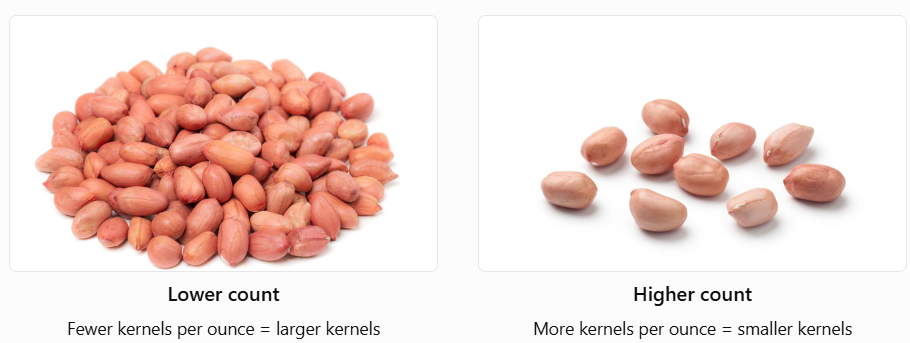
CPO stands for Counts Per Ounce. It is the sizing convention used for Indian groundnut kernels and it replaces the millimetre sizing used in some other origins. A count of 50/60 means there are between 50 and 60 kernels per ounce of weight. Lower numbers mean larger kernels. Higher numbers mean smaller kernels.
Count affects both the application and the price. For example, snack roasters and salted peanut manufacturers typically prefer lower counts, such as 40/50 or 50/60 Bold, because larger kernels offer better visual impact and more consistent roasting behaviour. Peanut butter manufacturers are less count-sensitive and often work with 60/70 or 70/80 material. Oil extraction facilities and industrial processors typically use higher-count material, which is more price-efficient.
When preparing a purchase order or RFQ, always specify the count as a range. Stating “Bold peanuts” without a count leaves the supplier to supply whatever count is most available at the time of production. If your line is calibrated to 50/60 material, receiving 70/80 kernels creates a production problem regardless of how good the quality is.
Groundnut Kernels Exporter from India: Specifications and Quality
The following table reflects Patel Agro Foods Industries’ current commercial specifications for export-grade groundnut kernels. In particular, it outlines the quality parameters that buyers should review before confirming an order. These are the parameters against which every shipment is tested before packing.
| Parameter | Bold 50/60 | Bold 60/70 | Java 60/70 | Java 70/80 |
|---|---|---|---|---|
| Moisture maximum | 7% | 7% | 7% | 7% |
| Admixture maximum | 1% | 1% | 1% | 1% |
| Oil content | 44–48% | 44–48% | 44–48% | 44–48% |
| Aflatoxin total (B1+B2+G1+G2) | 10 ppb max | 10 ppb max | 10 ppb max | 10 ppb max |
| Broken and splits maximum | 1% | 1% | 1% | 1% |
| Foreign matter maximum | 0.5% | 0.5% | 0.5% | 0.5% |
| Processing | HPS, Sortex sorted | HPS, Sortex sorted | HPS, Sortex sorted | HPS, Sortex sorted |
| COA | NABL-accredited, lot-wise | NABL-accredited, lot-wise | NABL-accredited, lot-wise | NABL-accredited, lot-wise |
EU-bound shipments are tested to B1 maximum 2 μg/kg and total aflatoxin maximum 4 μg/kg on request. APEDA-linked Certificate of Export and lot-wise COA from a NABL-accredited laboratory are provided with every commercial shipment.
When evaluating a groundnut kernels exporter from India, buyers should also confirm that the published specifications match the product actually offered and the requirements agreed for their shipment. This helps prevent misunderstandings about quality expectations before the order is confirmed.
Aflatoxin Requirements for Groundnut Kernel Imports
Aflatoxin is the primary compliance risk in groundnut export. It is a mycotoxin produced by Aspergillus moulds, typically during storage and handling under humid conditions. Every importing market has a limit. Shipments that test above the limit at the destination port are rejected, regardless of what the exporter’s COA shows.
Here is what each major market requires. Confirm the limit applicable to your specific product and intended use with your customs broker or food safety team before placing an order.
EU Aflatoxin Limits for Imported Groundnut Kernels
Under Commission Regulation EU 2023/915, the limits for aflatoxins in peanuts are:
For peanuts intended for direct human consumption or use as an ingredient: aflatoxin B1 maximum 2 μg/kg and total aflatoxins (B1+B2+G1+G2) maximum 4 μg/kg.
By comparison, peanuts that undergo sorting or other physical treatment before being placed on the market may fall under higher maximum levels: 8 μg/kg for aflatoxin B1 and 15 μg/kg for total aflatoxins. However, the applicable limits depend on the product category and intended use, so buyers should confirm which category applies to their shipment.
The applicable category depends on the intended use of your specific product. An ISO 17025 accredited laboratory must conduct the testing. The COA should show B1, B2, G1, and G2 individually alongside the total. HPLC or ELISA methods are the standard for EU compliance. Confirm with your EU customs authority or food safety team which method and reporting format is required for your specific import scenario.
US Aflatoxin Requirements for Peanut Imports
The US FDA action level for total aflatoxin in peanuts and peanut products is 20 ppb (micrograms per kilogram). FDA Prior Notice must be filed electronically before the shipment arrives at the US port. The importer of record must hold a valid FDA Food Facility Registration. Peanut shipments are subject to random sampling at US ports of entry.
Japan
Japan’s limit for total aflatoxin in peanuts is 10 ppb. Japan also applies its Positive List pesticide residue monitoring system to groundnuts, which is one of the more comprehensive pesticide frameworks globally. Buyers sourcing for Japanese markets should request an explicit pesticide residue compliance report alongside the aflatoxin COA.
Southeast Asia
Indonesia, Vietnam, Malaysia and the Philippines generally apply national limits alongside buyer-specific specifications. In practice, many food manufacturers in these markets set their own internal limits, which may be stricter than the applicable national requirements. Therefore, confirm the relevant limits with your buyer before finalising the purchase specification.
Middle East and GCC
Saudi Arabia follows Codex Alimentarius limits for aflatoxin. However, requirements can vary across the Gulf region. For example, buyers in the UAE may specify additional conformity or documentation requirements, while Halal certification may be necessary for certain products and destinations. In addition, some markets may request a health certificate alongside the phytosanitary certificate. Before preparing the shipment, confirm the complete documentation set with your buyer and customs broker.
Australia and New Zealand
Australia and New Zealand apply specific biosecurity conditions to peanut imports. Treatment requirements, documentation, and inspection conditions depend on the product type and import circumstances. Confirm the conditions applicable to your specific shipment through Australia’s DAFF BICON database or with your Australian importer before loading. Therefore, a reliable groundnut kernels exporter from India should be able to explain which test reports and export documents apply to the destination and shipment.
Groundnut Kernel Processing: Cleaning, Grading and Sorting
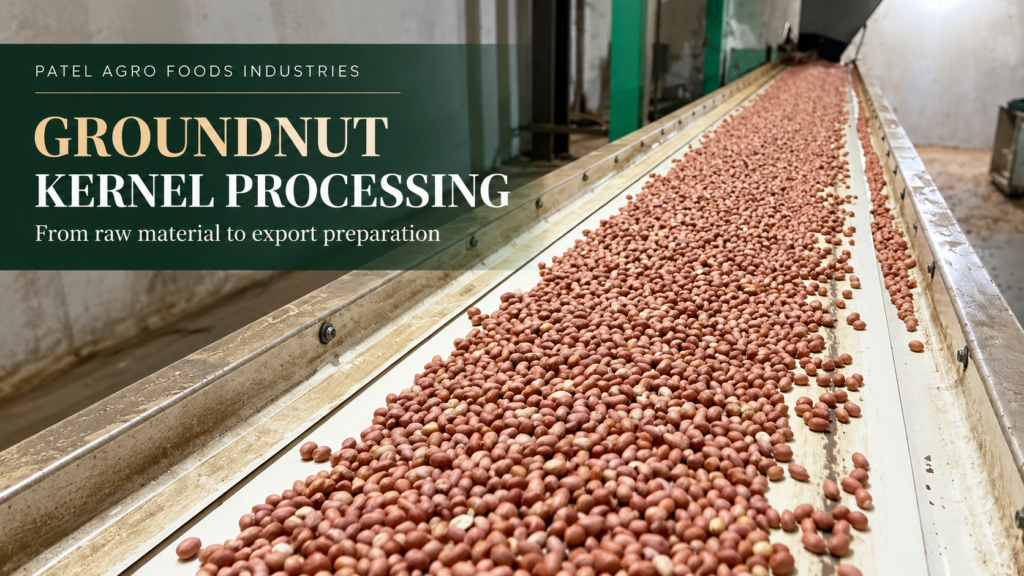
The gap between the farm-gate price and the FOB export price reflects several stages of handling and processing. Shelling machines first separate kernels from their pods. Next, cleaning equipment removes dust, shell fragments and other foreign matter, while sizing screens sort kernels into the count ranges specified by the buyer. Where gravity separation is available, the equipment removes lighter kernels that do not meet the required density. Finally, optical sorters identify visibly discoloured or off-grade kernels before packing.
Shelling
Raw peanuts arrive at the facility in shell. Shelling machines remove the pod to produce raw kernels. Shell yield varies between 65 and 72 percent depending on variety and crop condition.
Primary Cleaning
Aspiration systems and rotary sieves remove dust, shell fragments, and small foreign matter. As a first step, primary cleaning removes dust, shell fragments and other foreign matter before further processing.
Grading by Count
Sizing screens separate kernels into the commercial count ranges required by buyers. This step determines the CPO count of the finished lot.
Gravity Separation
During gravity separation, density-based equipment removes light, shrivelled or immature kernels that may have passed through the sizing screens but do not meet the required density. As a result, this step can help improve the consistency of the finished lot. This step improves purity and reduces the proportion of off-grade material in the finished lot.
Optical Colour Sorting
Colour-based Sortex sorting removes discoloured, mouldy, and off-grade kernels based on optical scanning. This is the processing step that separates a visually consistent, food-grade lot from a commodity-grade lot. At Patel Agro Foods Industries, all export-grade Bold and Java kernels pass through Sortex sorting before packing.
Metal Detection
As part of our processing controls, every export lot at PAFI passes through metal detectors before packing. We maintain detection records per lot. This is standard practice for food-grade processing and part of our ISO 22000 food safety management system.
Blanching (on request)
Blanching removes the skin from the kernel through steam or dry heat followed by mechanical rubbing. Blanched Bold and Java kernels are available on request for buyers in peanut butter manufacture, confectionery, and food manufacturing applications where skin-off material is required. Blanching is performed at our own facility. However, blanched lots generally require slightly more lead time than raw shelled material.
Export Documents for Groundnut Kernels from India
Document requirements vary by destination. The following sections explain what each document covers and when buyers typically need it. However, requirements vary by destination, product and intended use. Confirm the complete documentation set for your specific shipment before loading.
APEDA Certificate of Export
All groundnut exports from India are subject to APEDA registration and aflatoxin certification through APEDA’s dedicated traceability system for groundnuts. The APEDA Certificate of Export confirms the exporter is registered, that the lot has been tested at an APEDA-approved laboratory, and that the test results are within APEDA’s acceptable parameters. Request the APEDA certificate reference number from your supplier and verify the registration at apeda.gov.in.
Certificate of Analysis
Request a COA from a NABL-accredited or ISO/IEC 17025-accredited laboratory, as appropriate for the required test. The report should identify the lot, testing date and analytical method for each parameter. For aflatoxin testing, ask the laboratory to report B1, B2, G1 and G2 individually, alongside the total.
Phytosanitary Certificate
India’s National Plant Protection Organisation (NPPO) issues the phytosanitary certificate. Most importing countries require this document for plant-health clearance. Before shipment, confirm the specific requirements for your destination.
Certificate of Origin
Issued by APEDA or the Chamber of Commerce. The Certificate of Origin is required by many importing countries and is particularly important when preferential tariff rates apply under bilateral trade agreements. In such cases, the certificate helps establish the product’s declared country of origin for customs purposes.
Fumigation Certificate
Several importing markets require a Fumigation Certificate depending on the destination and product type.
Commercial Invoice and Packing List
Standard trade documents confirming the commercial terms, quantity, and packaging details of the shipment.
Bill of Lading
Issued by the shipping line. Required for customs clearance at the destination port.
For US-bound shipments, we file FDA Prior Notice electronically before arrival. EU organic shipments require a Transaction Certificate per shipment alongside the organic certificate.
Common Sourcing Mistakes: What Buyers Get Wrong the First Time
These are patterns that appear repeatedly in first-time import relationships. All of them are avoidable.
Specifying the variety without specifying the count
Ordering “Bold peanuts” without a CPO count means the supplier supplies whatever count is available. If your production process is calibrated to a specific kernel size, receiving a different count range can create a practical problem that cannot be resolved after the container is loaded. For this reason, specify the required count range and agreed tolerance in your purchase order. Always specify the count as a range.
Not distinguishing HPS from machine-cleaned in the specification
Two quotations for “Bold 50/60” may represent different processing levels. For food manufacturing and snack applications, specify HPS explicitly. For oil extraction and industrial use, machine-cleaned may be sufficient and more cost-efficient. Do not leave this unstated.
Assuming all aflatoxin tests are equivalent
TLC, ELISA, and HPLC are different testing methods with different detection sensitivities and result formats. EU compliance generally requires HPLC or ELISA with individual fractions reported. TLC results may not be accepted for EU import purposes by all member state customs authorities. Confirm which method and format is required before placing the order.
Not requesting a sample before the first container
A sample drawn from a recent commercial processing lot, accompanied by the COA from the same lot, gives you the quality baseline for the commercial shipment. Before confirming the purchase order, test the sample against your specification. By identifying any differences early, you can address quality gaps before the commercial shipment is dispatched. This is far easier than discovering a mismatch after 20 MT has arrived at your warehouse.
Not confirming fumigation requirements before loading
Fumigation requirements vary by destination and product. Discovering that your destination requires a specific treatment certificate after the container is sealed creates delays and costs that could have been avoided with one pre-shipment confirmation.
Leaving moisture maximum unstated in the purchase order
Moisture affects storage stability and microbiological risk during sea transit. Therefore, state the maximum moisture level explicitly in your purchase order. For many food manufacturing applications, 7% is the specified maximum, although the final limit should match your buyer’s requirements. Assuming the supplier will default to your preferred level without it being stated is one of the most common errors in first-time peanut procurement.
RFQ Checklist for a Groundnut Kernels Exporter from India
An RFQ that gives a groundnut kernels exporter from India the following information gets a precise, comparable quotation within 24 hours.
Product and quality specification
- Variety: Bold, Java or another agreed type
- Kernel count: Required range and counting convention
- Processing: HPS, machine-cleaned, raw shelled or blanched, as applicable
- Moisture: Maximum agreed level
- Quality limits: Admixture, foreign matter, broken kernels and other agreed parameters
- Food safety: Aflatoxin limits, testing requirements and other destination-specific checks
Quantity and commercial terms
- Quantity: Tonnes per shipment and estimated annual requirement
- Packaging: Bag material, weight and printing requirements
- Destination: Country and port
- Incoterm: FOB, CFR, CIF or another agreed term
- Shipment window: Required loading period
- Payment: Preferred commercial terms
Documents and inspection
Specify the certificates, laboratory reports and traceability records required for the destination. In addition, state whether pre-shipment inspection is required and identify the inspection body, if already agreed.
Submit your groundnut sourcing enquiry with these details to [email protected]. We respond with current pricing, specifications, and sample availability within 24 business hours.
A detailed RFQ helps a groundnut kernels exporter from India quote against the same grade, quality parameters, packaging and commercial terms that your business requires.
Frequently Asked Questions About Groundnut Kernels Exporters from India
Bold kernels are larger, oval-shaped, and grown primarily in Saurashtra, Gujarat. They are preferred for snack roasting, salted peanuts, and peanut butter. Java kernels are smaller and rounder, used for peanut butter, confectionery, peanut sauce, and oil extraction.
HPS stands for Hand Picked and Sorted. It is a processing standard in which kernels are hand-sorted after mechanical cleaning to remove damaged, shrivelled, discoloured, and immature material. HPS is specified by EU buyers and premium food manufacturers. Machine-cleaned lots are processed mechanically without the hand-sorting step and are appropriate for oil extraction and industrial processing.
Under Commission Regulation EU 2023/915, the limit for peanuts for direct human consumption or use as an ingredient is aflatoxin B1 maximum 2 μg/kg and total aflatoxins maximum 4 μg/kg. For peanuts subject to sorting or physical treatment before the market, the limits are B1 maximum 8 μg/kg and total aflatoxins maximum 15 μg/kg. Confirm which category applies to your product with your EU food safety team.
Shelled groundnut kernels are classified under HS code 1202 42 00. Peanuts in shell are under 1202 41 00. Confirm the applicable import tariff code for your destination country with your customs broker.
PAFI’s standard minimum order quantity for export is 1 MT. In addition, trial quantities may be available for new buyers who want to assess product quality before committing to a full-container order. Please confirm availability and the applicable commercial terms when requesting a quotation. A 20ft FCL holds approximately 19 to 20 MT in 25kg PP bags.
Every PAFI shipment includes: APEDA Certificate of Export, lot-wise COA from a NABL-accredited laboratory (with individual aflatoxin fractions), Phytosanitary Certificate, Certificate of Origin, Commercial Invoice, Packing List, and Bill of Lading. Fumigation Certificate available where required. FDA Prior Notice filed for US-bound shipments. EU MRL pesticide residue report available on request.
Yes. PAFI supplies blanched Bold and Java kernels processed at our own facility in Deesa. Available in the same count ranges as raw shelled material. Contact us with your count, volume, and destination requirements.
Organic certified groundnut supply is subject to certification availability and destination requirements. Contact us with your specific certification requirement and destination market for current status.
There is no single price. It varies by variety, count, processing level, certification, volume, and shipment timing. For current pricing specific to your specification and destination, send your RFQ to [email protected]. We respond within 24 business hours with pricing, specifications, and sample availability.
Choosing a Groundnut Kernels Exporter from India for Repeat Supply
Patel Agro Foods Industries is an APEDA-registered agri-processor and exporter based in Deesa, Banaskantha, Gujarat, operating since 1992. We supply Bold and Java groundnut kernels in HPS and machine-cleaned grades, in counts from 50/60 to 70/80, with NABL-accredited lot-wise COA for every commercial shipment.
If you are assessing a groundnut kernels exporter from India for repeat commercial supply, share your required count, processing level, destination and food-safety specification with PAFI.
Email: [email protected]
Phone: +91 98254 58490
Submit your sourcing enquiry at patelagrofoods.com/contact
We respond to all importer enquiries within 24 business hours.
